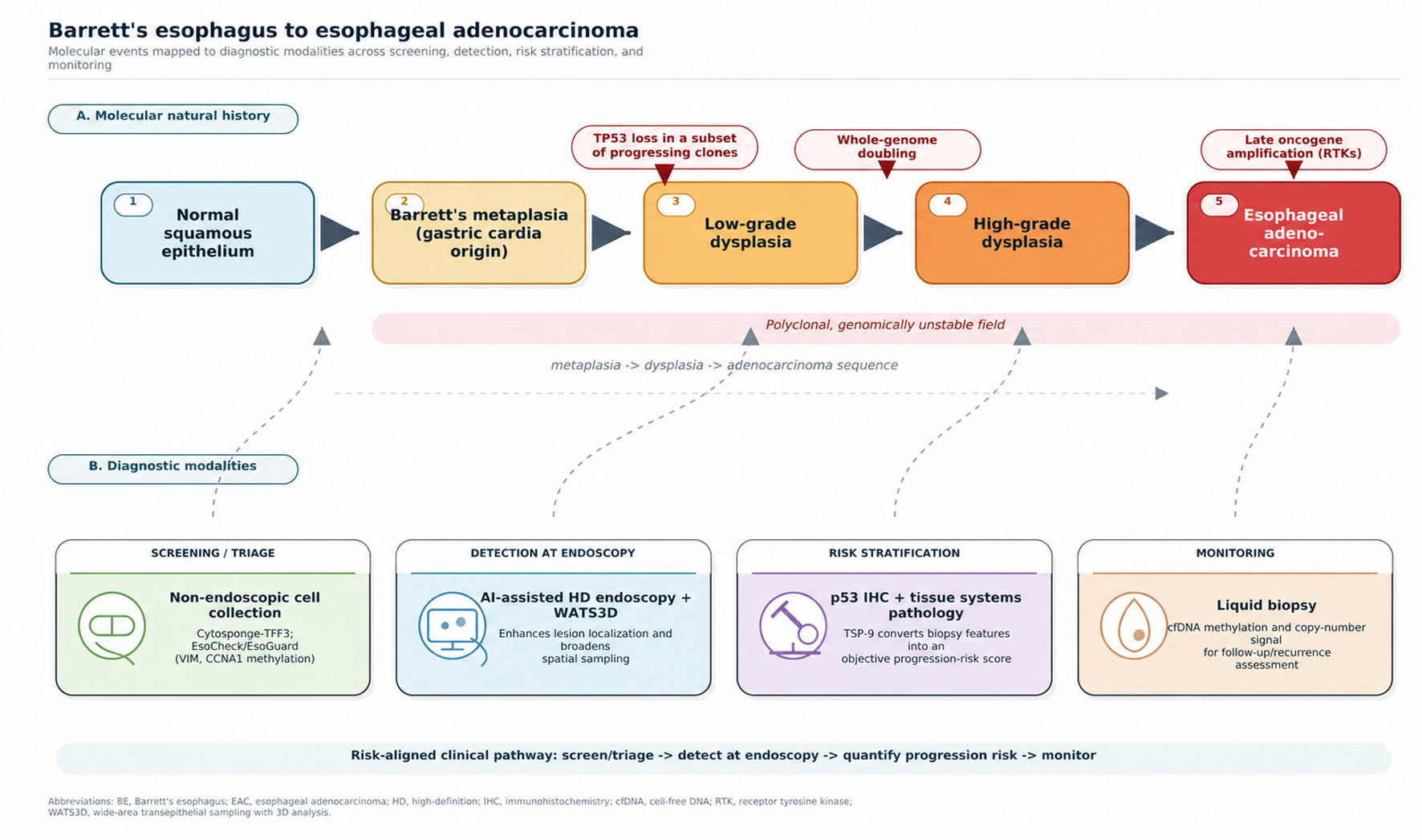
| p53 IHC/biopsy | Low-cost, widely available adjunct to dysplasia interpretation | Single pathway; retains biopsy-sampling and scoring variability | Progression association RR 14.25; standalone sensitivity/specificity not established | Adjunct to expert pathology; routine biomarker-directed surveillance is not recommended | [14, 32] |
| TSP-9/TissueCypher/FFPE biopsy | Objective nine-biomarker risk class with high NPV | Proprietary centralized assay; moderate sensitivity; mainly retrospective or industry-associated evidence | Pooled sensitivity 61%, specificity 81%, NPV 97% | Selective risk-stratification adjunct where available; no current AGA recommendation | [17–19, 32, 33] |
| WATS3D/brush | Broad spatial sampling and incremental dysplasia detection | Adjunct only; heterogeneous studies and uncertain natural history of WATS3D-only dysplasia | Incremental dysplasia yield 7.2%; standalone sensitivity/specificity not established | Adjunct to Seattle-protocol biopsy where expertise exists; no current AGA recommendation | [20, 32] |
| Cytosponge-TFF3/sponge | Scalable non-endoscopic screening/triage with randomized and economic evidence | Positive tests require endoscopy; uptake, laboratory pathways, and availability vary | Pooled sensitivity 81% and specificity 89% for BE of any circumferential length | Screening/triage in selected systems; not a replacement for diagnostic endoscopy | [22, 23, 34] |
| EsoCheck/EsoGuard/balloon | Rapid sampling with methylated VIM and CCNA1 detection | Commercial assay; confirmatory endoscopy; predominantly White cohort; industry involvement | Sensitivity 85%, specificity 85%; 18/18 cancers detected in 243 evaluable participants | Selected non-endoscopic screening/triage where available; outcome validation is needed | [25] |
| Liquid biopsy/cfDNA | Minimally invasive and suitable for serial monitoring | Insufficient sensitivity for nondysplastic BE or early EAC; specialized analysis | Signal mainly detected in metastatic disease; early-disease sensitivity/specificity not established | Research and response/recurrence monitoring; not primary BE screening | [26] |
| AI CAD/endoscopic image or video | Real-time lesion localization and targeted-biopsy support | Image-quality and external-validation dependence; workflow, regulatory, and training requirements | Validation dataset: sensitivity 90%, specificity 88%, accuracy 89% | Adjunct to high-quality endoscopy; not a molecular test or replacement for structured biopsy | [27] |